How SportyBet Came to Own Half of Ghana's Betting Market
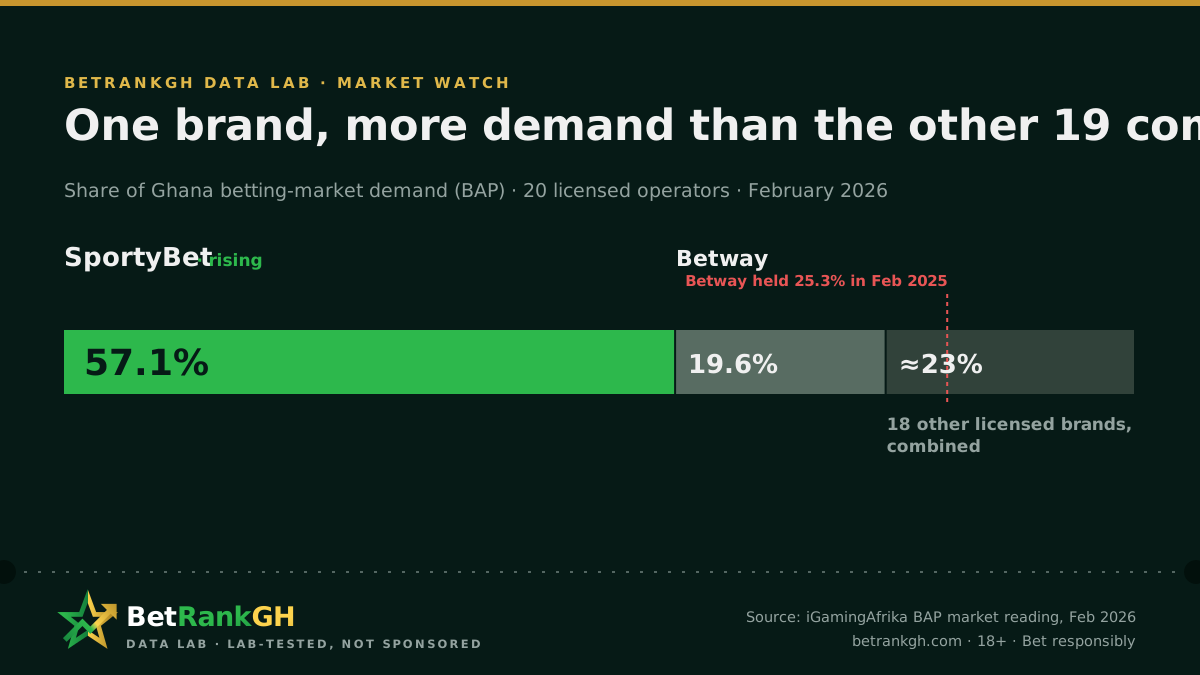
Two years ago, Ghana's betting market was routinely described as a duopoly: SportyBet and Betway, running roughly neck and neck, with everyone else fighting for scraps. That framing is out of date. As of the most recent market-demand reading in February 2026, SportyBet alone commands 57.1% of BAP (Brand's Accumulated Power, a brand's share of total market demand for a given country and period), and captures close to 59% of online sports betting demand specifically. Betway, the brand it used to be neck and neck with, has fallen to 19.64%, down from 25.29% in the prior period. Between them, the two brands now account for more than three-quarters of the entire market, and only one of them is still growing.
This isn't a story about SportyBet appearing out of nowhere. It's a story about a market that consolidated fast, and about what happens to bettors when a market stops looking like a genuine contest between equals.
Context matters here: Ghana's regulated gambling market has been growing fast in absolute terms too, industry estimates put it near $900 million in gross win with double-digit annual growth, and over 20 brands hold active Gaming Commission of Ghana licenses. So this isn't a shrinking market where one survivor is left standing. It's a growing market where one brand is capturing a disproportionate and increasing share of the growth itself, while a field of 19 other licensed competitors, including some genuinely large international names, fights over what's left.
From Duopoly to Near-Monopoly: The Numbers
What makes this genuinely a "near-monopoly" story rather than just "one brand is popular" is the direction of travel. Betway isn't a smaller brand that never caught up, it's a brand that was losing share while SportyBet was gaining it, in the same reporting window. A market where the runner-up is shrinking looks structurally different from one where it's simply behind.
Why SportyBet Is Winning
None of this is an accident of marketing budget. Three product decisions explain most of the gap:
- MTN MoMo integration built for speed. SportyBet's withdrawal processing (reported up to GHS 750,000 same-day) leans directly into what Ghanaian bettors actually care about: getting paid fast, in the wallet they already use for everything else.
- Sharper odds margins. A tighter book means better prices on the exact markets, Ghana Premier League and English Premier League football, that make up the overwhelming majority of local betting volume.
- Local-first positioning. While Betway competes as a global brand with a Ghana presence, SportyBet's product decisions read as built around the local bettor first, not adapted for the market second.
None of these three things are secrets. They're all things any competitor could, in theory, copy. That's exactly what makes the widening gap notable: this isn't a temporary promotional push that fades once a rival matches it, it's a compounding product and payments advantage that's held up over multiple reporting periods in a row.
How Concentrated Is "Near-Monopoly," Really?
Put the 57.1% figure next to what a genuinely competitive licensed market usually looks like, and the gap is stark. In a healthy multi-operator market, it's common for the top three brands to split something like 25-30%, 20%, and 15%, with a long tail of smaller operators filling the rest, no single name close to an outright majority. Ghana's market now has one operator alone holding more demand than the next nineteen combined. That's not "the market leader," in the sense most regulated betting markets use the term. It's a single brand functioning as the default choice for most bettors, with everyone else competing for what's structurally a much smaller remaining pool than the headline "20+ licensed operators" number suggests.
The PrideSpins Signal: The Door Isn't Fully Shut
The one genuine counter-data-point in this reading is PrideSpins, which entered the top ten brands by demand share for the first time in February 2026. It's a small brand relative to the two leaders, but its appearance matters analytically: it proves a new entrant can still break through in a consolidating market, provided it has both a credible local license and a product that actually competes rather than just undercuts on bonus size. Consolidation makes new entries harder, not impossible.
What This Actually Means for Your Odds
A market this concentrated changes the incentive picture, and not necessarily in the bettor's favour. Aggressive competition between genuinely comparable rivals is usually what forces operators to keep margins tight and promotions generous. When one brand pulls decisively ahead and its nearest rival is shrinking rather than pushing back, the competitive pressure that keeps prices sharp weakens too. That's not a prediction that SportyBet's odds will get worse tomorrow. It's a reason to keep doing the thing a concentrated market makes easy to stop doing: actually comparing prices across more than one bookmaker before you stake, rather than defaulting to whichever app has the most friends using it.
Worth noting too: this reading landed during what's typically the quietest stretch of the Ghanaian betting calendar. European domestic leagues are in their off-season through June and July, and demand visibly drops in that window before picking back up as the new season approaches. Market-share figures captured in this period reflect underlying brand strength more than seasonal noise, since there's less tournament-driven traffic to distort them either way.
None of this is necessarily permanent. PrideSpins' emergence shows new entrants can still gain a foothold, Betano only launched in Ghana in February 2026 and is still building distribution, and a market this concentrated tends to eventually attract regulatory attention purely because of what concentration usually does to consumer outcomes over time. The Ghana Premier League's 2026/27 season kicking off in September and the AFCON 2027 qualifiers starting the same month will both be genuine tests of whether Betway or anyone else can claw back ground during the highest-demand stretch of the calendar, or whether SportyBet's lead simply compounds further.
Trap Bet: "Everyone uses SportyBet, so it must have the best odds." Popularity and pricing are different things. The brands winning market share are winning it on withdrawal speed and product polish as much as on price, so the sharpest odds on any given match won't always sit with the biggest brand. Check our toplist before assuming the most popular app is also the best-priced one for your bet.
Note: Read our full SportyBet review and Betway review before deciding where to bet. And if betting ever stops feeling like a choice, our guide to free, confidential help in Ghana is there for you.