Arbitrage and Surebets in Ghana: Is "Risk-Free" Betting Actually Legal and Practical?
Somewhere in every betting Telegram group, someone is selling "risk-free" arbitrage betting software, promising guaranteed profit with zero downside because you're technically betting on both sides. The pitch isn't a lie, arbitrage betting, sometimes called surebetting, is a real, mathematically sound strategy. What the pitch leaves out is everything that happens after you place the first bet: whether it's actually legal here (the honest answer to "is arbing illegal in Ghana" is no), and whether the bookmakers you need it to work against will let you keep doing it once they notice.
At BetRankGH, we don't tip. We find where the odds don't match the actual probability, and arbitrage betting is the purest version of that idea, betting across bookmakers whose prices disagree with each other rather than trying to predict a result. It's also a case study in the gap between "mathematically guaranteed" and "practically sustainable."
What Arbitrage Betting Actually Is
We've covered how a single bookmaker's odds always carry a built-in margin, the overround, that makes the implied probabilities on one market sum to more than 100%. An arbitrage opportunity is the mirror image of that: it exists when you can find the best-available price on every outcome of an event across different bookmakers, and the sum of those implied probabilities comes out under 100%. Stake proportionally across each outcome, and whichever one wins, you collect more than you staked overall.
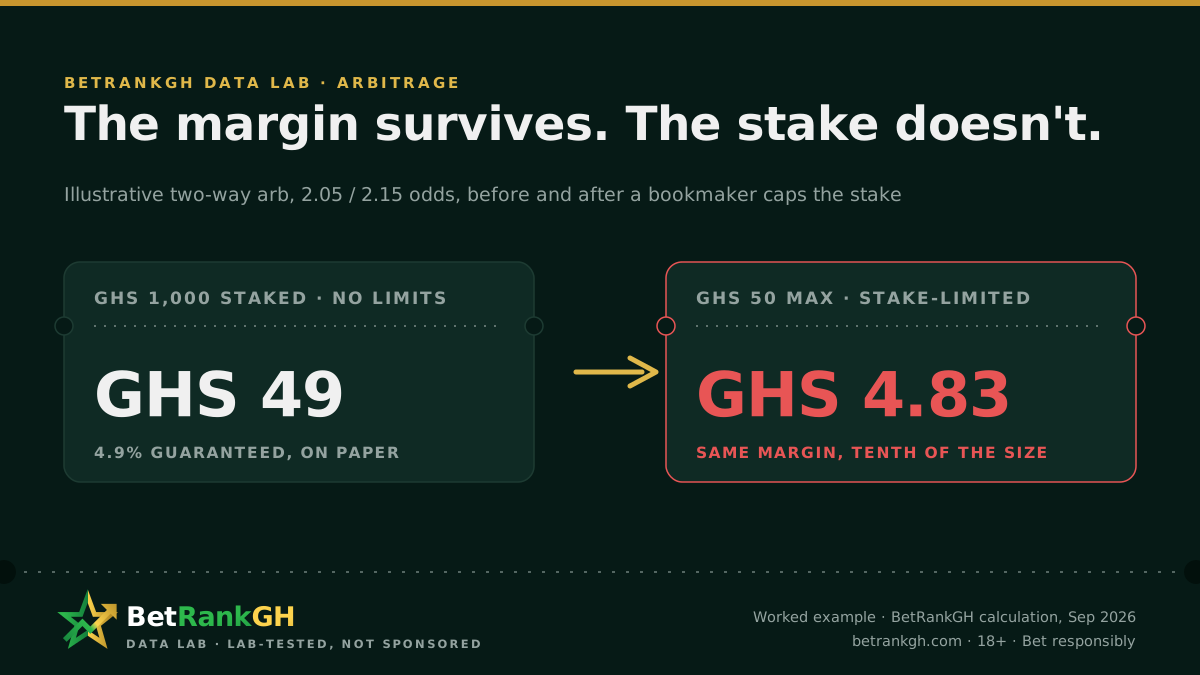
A clean, illustrative example: Bookmaker A prices one side of a two-outcome market at 2.05, Bookmaker B prices the other side at 2.15. Convert both to implied probability (1 ÷ odds) and they sum to 95.3%, a 4.7-point gap under 100%. Split a GHS 1,000 total stake proportionally across both bookmakers, and the math guarantees roughly GHS 49 profit regardless of which side wins. That's the whole mechanism. No prediction skill required, just fast, careful arithmetic and accounts open at both books.
How a Genuine Arb Actually Gets Found
In practice, nobody scans dozens of bookmaker odds pages by hand looking for a 4-5% gap; the margins that thin close within minutes as other bettors and the bookmakers' own automated pricing systems react. Arbers typically rely on dedicated odds-comparison software that scrapes multiple sportsbooks' live prices simultaneously and flags any market where the cross-bookmaker implied-probability sum drops under 100%. That software is a real, purchasable product category, not itself illegal to use, but it's also not going to hand you a Ghana-specific edge, most tools are built around global bookmakers and major leagues, and the gap between a flagged opportunity and actually getting both bets placed before either price moves is measured in seconds, not minutes.
Is It Actually Legal in Ghana?
Yes, and this part is genuinely simple. Ghana's Gaming Act 2006 and the Gaming Commission's licensing framework regulate who can operate a betting business, not what combination of legal bets a customer chooses to place. There is nothing in Ghanaian gambling law that prohibits placing one bet at SportyBet and an opposing bet at Betway on the same match. Arbitrage betting isn't a legal grey area here, it's just two separate, perfectly ordinary bets that happen to be mathematically related. If you're looking for a law being broken, there isn't one.
Worth a specific, related note since it comes up often: any profit from arbitrage betting sits under the same 2026 tax position as every other betting win in Ghana. The 10% withholding tax on winnings was scrapped in April 2025 alongside the E-Levy, so a genuine arb profit lands in your MoMo wallet in full, no special deduction for how the win was generated, exactly as covered in our guide to the current tax rules.
What isn't automatically legal, and matters far more than the strategy itself, is how some bettors try to scale it once a bookmaker limits them. Opening multiple accounts under false identities, a friend's name, a relative's Ghana Card, to dodge a stake limit isn't arbitrage betting, it's identity misuse against a licensed operator's KYC obligations, and that's a genuinely different, much riskier thing than the underlying math strategy, closer to the ground our license verification guide touches on when it comes to account integrity.
Legal Isn't the Same as Welcome: Account Limiting in Practice
Here's where the "risk-free" pitch starts to fall apart. A licensed sportsbook is a private business, and its terms and conditions are a separate contract from Ghana's gambling law entirely. Virtually every operator's T&Cs explicitly prohibit what they describe as risk-free or hedged betting patterns, and they have real detection tools for it: stake sizing that doesn't match typical recreational behaviour, timing patterns that cluster right before odds move, and betting structures that show zero net risk across correlated accounts. None of this requires proving intent. The pattern itself is the trigger.
The Gaming Commission's own consumer-protection rules focus on things like honest advertising, responsible-gambling safeguards, and an operator's obligation to return your balance if you close your account, exactly the ground our license verification guide covers. Nowhere in that framework does GCG regulate how an operator prices risk from its own customers. Stake-limiting a suspected arber isn't a violation of anything GCG oversees, it's a private commercial decision the operator is free to make, the same way a casino can decline to deal to a card counter.
In practice, most operators don't close an arbitrage account outright, closing accounts and returning balances draws more attention than quietly throttling one. The far more common response is exactly what the worked example below shows: the account keeps working, logins succeed, bets still get accepted, but the maximum stake on the specific markets that flagged the pattern shrinks to a level where the strategy stops being worth the effort. In the wider arbitrage and matched-betting community, this is widely known as being "gubbed," a UK betting-forum term for an account that's still open but functionally neutered, and the exact same pattern applies here regardless of what word you use for it.
The Real Math: Why "Risk-Free" Rarely Survives Contact With Reality
Go back to the GHS 1,000 example. The 4.7% edge is genuine, right up until a bookmaker notices the pattern and caps your stake on that market to, say, GHS 50. The margin doesn't disappear, it's still the same 4.7% gap, but the profit it can generate shrinks with the stake.
A guaranteed GHS 4.83 for tying up capital across two separate accounts, tracking two separate bet slips, and managing two separate withdrawal relationships is a very different proposition from the "guaranteed profit" pitch software sellers advertise. And Ghana adds a specific practical friction on top: our own payments guide covers the closed-loop rule, winnings must return to the same MoMo wallet that funded the account. Run arbs across four or five operators and you're not managing one bankroll, you're managing four or five separate, KYC-verified, wallet-locked pools of capital, each with its own withdrawal timeline.
Trap Bet: Treating a bookmaker's own boosted or enhanced-odds promotion as a genuine arbitrage opportunity. Promotional prices are deliberately generous marketing loss-leaders, and operators cap them at small stakes for exactly that reason. It's precisely the pattern their arbitrage-detection systems are built to catch fastest, since the operator already knows the promo is mispriced and is watching for anyone trying to exploit it at scale.
What This Actually Means If You Try It
Arbitrage betting is legal in Ghana, mathematically sound, and genuinely not the free money it's marketed as once you account for how licensed operators actually respond to it. Realistic margins in efficiently-priced major markets tend to run thin, often under 2%, before any limiting happens at all. Add stake caps, multi-operator capital fragmentation, and the closed-loop payment rule, and the honest picture is: a real, legal strategy with a shelf life that shortens the moment it starts working well enough for a bookmaker to notice.
Note: Whatever strategy you're running, staking it correctly is its own discipline, covered in our bankroll management guide. And if betting ever stops feeling like a choice, our guide to free, confidential help in Ghana is there for you.