Odds Are Just Probabilities: Reading a Betting Line Without Paying Anyone for Tips
"Sure banker," "today's fixed games," "100% correct score," Ghana's betting Telegram and WhatsApp groups run on a simple promise: someone else has already done the hard part, and all you have to do is pay for the answer. The actual hard part isn't finding a winner. Nobody can reliably do that match after match. The actual hard part, and the one skill that genuinely replaces buying tips, is reading what a bookmaker's own odds are telling you about probability, and comparing that against your own honest read of the game.
At BetRankGH, we don't tip. We find where the odds don't match the actual probability. This is the arithmetic behind that sentence, in full, so you can run it yourself on any market, for free, forever.
The One Formula That Replaces Every Tipster
Every betting price is a probability wearing a disguise. Decimal odds, the format every licensed Ghanaian bookmaker uses, convert to an implied probability with one division: implied probability = 1 ÷ decimal odds. Odds of 2.00 imply a 50% chance. Odds of 4.00 imply 25%. Odds of 1.25 imply 80%. That's the entire formula. Anyone selling you a "banker" is, whether they say so or not, implicitly claiming their pick's real chance is higher than what that division gives you. The honest version of that claim is arithmetic you can check yourself in five seconds, not a WhatsApp message you pay for.
Why the Three Prices Never Add to 100%
Run that formula on all three outcomes of a normal home/draw/away market and something odd happens: the percentages add up to more than 100%. That gap is not a rounding error, and it's not the bookmaker being bad at maths. It's the bookmaker's built-in margin, usually called the overround or the "vig," and it's how a sportsbook makes money on a fair coin flip and an unfair one alike. Every single market on every single bookmaker carries one; the only question is how big it is.
A Worked Example: Stripping the Margin From a Three-Way Market
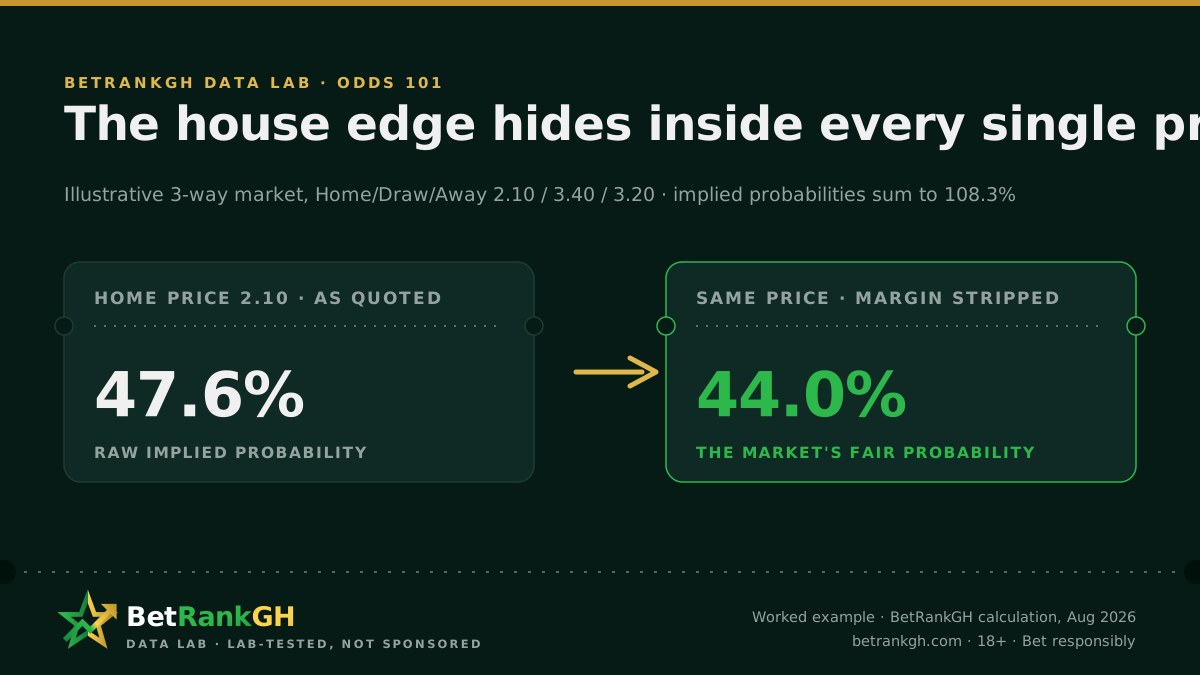
Take a hypothetical Ghana Premier League home/draw/away market priced at Home 2.10, Draw 3.40, Away 3.20, illustrative numbers, not a live line on any specific fixture. Convert each to implied probability the same way:
Those three numbers sum to 108.3%, and that extra 8.3 percentage points is the bookmaker's margin on this market, priced into every one of the three outcomes at once. To get the "fair" probabilities, the market's own honest read of the game once the house edge is removed, divide each implied probability by the total: 47.6 ÷ 108.3 gives a fair Home probability of 44.0%, Draw becomes 27.2%, and Away becomes 28.9%. Those three numbers do sum to 100%, and they're the actual comparison point for judging whether a price is good value, not the raw implied percentages, which always overstate every outcome a little by design.
What This Skill Actually Buys You
Here's the part a calculator can't do for you, and the part no tipster can honestly sell you either: forming your own view of the real probability, from team news, form, fixture context, whatever you actually know about the match, and comparing your number against the market's fair-stripped number. If your honest read says a team's true chance is 50% and the fair-stripped market says 44%, that's a specific, checkable disagreement between your view and the market's, and it's the only kind of "value" that means anything. A tipster's "banker" gives you a conclusion with the arithmetic hidden. This method gives you the arithmetic, so the conclusion is yours to own, right or wrong.
It's also the fastest way to spot a bad bet before you place it. If your own honest assessment of a team's chances is actually lower than the fair-stripped market probability, the price isn't offering you anything, no matter how confident the tipster message sounded typing it out at 6:45pm before kickoff.
Forming that honest assessment is its own skill, and it's worth being clear about what goes into it rather than treating it as a black box: confirmed lineups rather than the squad list from last week, which side is carrying fixture congestion into the match, recent form against similar opposition rather than results in isolation, and whether the market itself has already moved in a direction your other information doesn't explain. None of that produces a single "correct" number the way the overround arithmetic does. It produces your best honest estimate, which is exactly the point, an estimate you built and can defend, not one you bought from a stranger with an incentive to sound certain.
The Same Method on a Two-Way Market
Three-way home/draw/away markets aren't the only place this arithmetic applies, and the two-way version is if anything easier to run in your head. Take an illustrative Over/Under 2.5 goals market priced at Over 1.90 and Under 1.95. Implied probability on Over is 1 ÷ 1.90 = 52.6%; on Under it's 1 ÷ 1.95 = 51.3%. Those sum to 103.9%, a tighter margin than the three-way example above, which is typical: two-way markets generally carry a smaller overround than three-way or multi-selection markets, simply because there are fewer outcomes for the bookmaker to price a cushion into. Strip that 3.9% out the same way, dividing each side by the total, and the fair probabilities land at roughly 50.6% Over and 49.4% Under, essentially a coin flip with a very thin edge either way.
That pattern holds generally: the more selections a market has, the more room a bookmaker has to build in margin without any single price looking obviously inflated. Same-game bet builders and correct-score markets, which we've covered separately, routinely carry far fatter overrounds than a plain match-result market for exactly this reason. Checking the overround isn't just an academic exercise, it's a genuine signal of which markets are priced tightly enough to be worth engaging with in the first place.
Reading Odds Movement as Information
The same arithmetic explains why a price moving before kickoff matters. When a market shortens, say Home moves from 2.10 to 1.90, the implied and fair probabilities both rise, and that's the market absorbing new information, team news, weight of money, or simply sharper bettors acting first, not randomness. We've written separately about how this plays out in-play, where the gap between the market's near-instant repricing and a delayed stream creates a specific, exploitable timing problem. The underlying mechanic is identical: the odds are the market's live probability estimate, and every genuine piece of information gets reflected there before it gets reflected anywhere else.
Trap Bet: Reading a price like 2.00 as a literal coin flip. That 50% figure is the raw implied probability, before the bookmaker's margin is stripped out. Once you divide by the market's total (usually somewhere around 105-110% for a standard three-way football market), the fair probability behind that same 2.00 price is genuinely lower than 50%, every single time, on every single market, by design.
None of this replaces judgement, and it was never meant to. It replaces paying someone else for theirs while they hide the one piece of arithmetic that would let you check their work. Do the division yourself, strip the margin, and compare the result against what you actually think. That's the whole method, and it costs nothing to run on the next market you look at.
Note: Turning a genuine price disagreement into a stake size is a separate skill, our bankroll management guide covers that framework. And if betting ever stops feeling like a choice, our guide to free, confidential help in Ghana is there for you.