Do Football Prediction Sites Actually Work? The Real Math Behind Their Accuracy Claims
Search "football predictions today Ghana" and you'll land on a dozen sites promising tomorrow's "sure banker," each one flashing an accuracy percentage in the 70s, 80s, sometimes higher. Some are free. Some want a subscription. All of them frame accuracy as the whole story: pick the site with the biggest number, follow its tips, win. At BetRankGH, we don't tip — we find where the odds don't match the actual probability, and the honest answer to "do prediction sites work" starts with a question none of them ask out loud: work compared to what?
The Accuracy Number That Means Almost Nothing on Its Own
A three-way football market (home, draw, away) has a baseline of 33% for a coin-flip guess. Roundups of free prediction sites commonly cite accuracy in the 45-55% range for match-result tips — comfortably above that baseline, which is exactly why the number gets marketed so hard. But 45-55% is also almost exactly what you'd get by doing nothing clever at all: just always picking the home team.
Our own three-season Ghana Premier League data (covered in full in our GPL stats analysis) puts the home win rate at roughly 40%, against about 30% draws and 30% away wins. Run that same split through a standard Poisson scoring model calibrated to GPL-like scoring rates and you land in the same neighbourhood: around 46% home, 28% draws, 26% away. A "predictor" that does nothing but back the favourite every single time will land inside that 45-55% "accuracy" range purely from the shape of football itself, with zero analysis and zero edge.
This isn't a specific accusation against any one site's methodology, most run genuinely more sophisticated models than "always pick the favourite." It's a statement about the metric: accuracy alone cannot distinguish a real predictive edge from doing the laziest possible thing correctly slightly more often than not. A useful test needs to compare against something the lazy strategy can't fake.
The demand for this kind of content in Ghana runs well beyond a handful of prediction websites. WhatsApp groups and Telegram channels selling "sure bankers" and "VIP odds" for a daily or weekly fee are a parallel, more aggressive version of the same pitch, often with far less transparency than even the free prediction sites. That specific mechanic, how a seller can show real, verifiable winning streaks to genuine subscribers while still being wrong close to half the time, is a big enough topic on its own that we cover it separately. The accuracy-versus-value distinction below applies just as directly there as it does to any free prediction site.
The Test Professionals Actually Use: Closing Line Value
Professional betting syndicates and trading desks don't judge a model by its win rate. They judge it by closing line value (CLV): whether the odds available when a pick was made were better than the odds available right before kickoff. A bookmaker's closing price absorbs every scrap of public information that arrived between a tipster's publish time and the first whistle, injury news, team-sheet leaks, sharp money, weather. If a site's picks consistently come in at odds shorter than they were when published, the market moved toward the tipster's view, which is the actual, checkable signature of an edge. If the price doesn't move, or drifts the other way, the pick added no information the market didn't already have.
This single idea is the real answer to "does this site work," and it's something any reader can check themselves without trusting a single self-reported percentage:
- Screenshot the odds at the moment a tip is published (most sites publish predictions a day or more before kickoff).
- Check the same match's odds again an hour before kickoff.
- If the price shortened in the direction of the tip, the market caught up to something the tipster saw early — a genuine, if small, signal.
- If the price held or drifted, the tip was reading the same public information everyone else had, dressed up as insight.
Do this across even ten picks from a site you're considering paying for, and you'll learn more about its real value than any advertised win-rate ever tells you. A worked illustration of what the two outcomes actually look like: a tip published at odds of 2.10 that drifts down to 1.85 by kickoff means real money followed the same read, genuine signal. A tip published at 1.75 that drifts out to 1.90 means the market moved away from it, the opposite of a signal, no matter how the result eventually landed. The final score tells you nothing about which of those two happened; only the price movement does.
How a Site Inflates "Accuracy" Without Ever Lying
There's a second, quieter way accuracy claims mislead that has nothing to do with picking favourites: publishing mostly safe, heavily-favoured matches in the first place. A site that mainly tips overwhelming favourites (a title-chasing side at home to the division's bottom club, a European giant against a part-time domestic opponent) will post a high hit rate almost by construction, those matches were never close calls. The catch is that the bookmaker already knows they're one-sided too, which is exactly why the odds on the favourite are so short. A 90% "accuracy" record built entirely on 1.15-odds bankers is mathematically unremarkable and, once you account for the tiny returns those prices pay, can still lose money on the bets that don't land. High accuracy and genuine value are two different claims, and a site advertising only the first is telling you a true but incomplete story.
A Checkable Claim Worth Applying This To
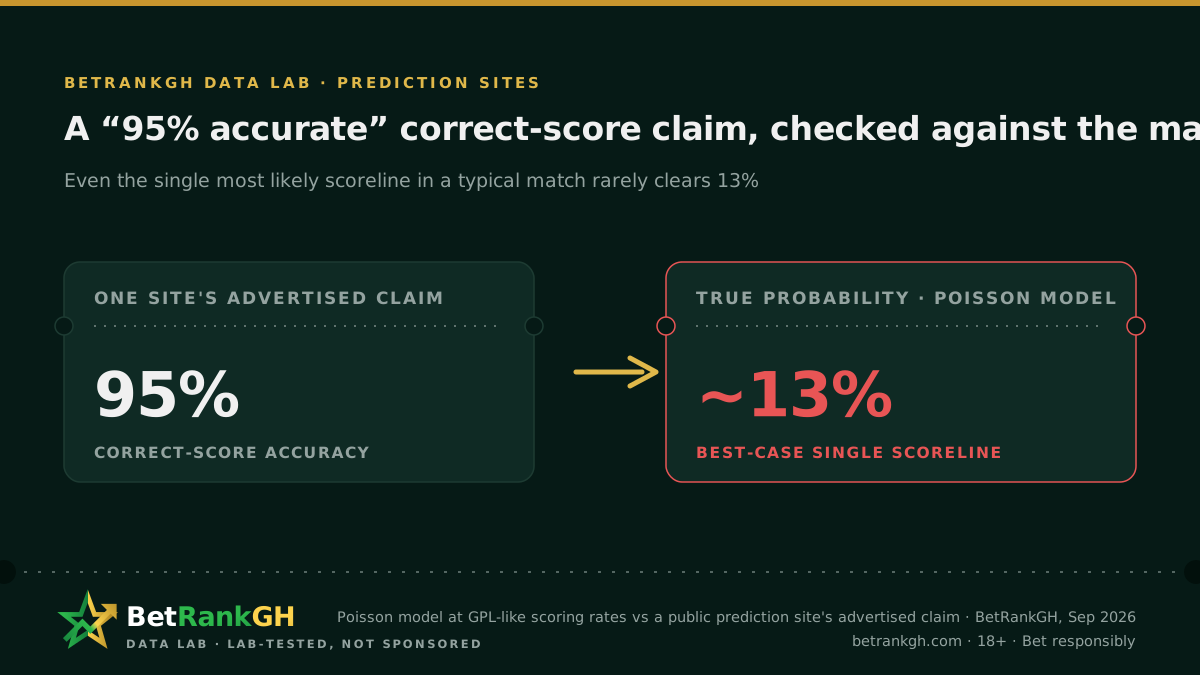
One free prediction site currently advertises a "proven 95% accuracy rate" specifically for its correct-score predictions. Correct score is the hardest common market to call precisely because it demands an exact outcome, not just a direction, and it's worth running the actual numbers rather than taking the figure at face value.
Using a standard Poisson scoring model at realistic Ghana Premier League-like scoring rates (a method we walk through in full in our correct-score Poisson guide), even the single most probable scoreline in a typical match, usually a narrow 1-0 or 1-1, carries a true probability of roughly 12-14%. Nothing in the maths of how goals actually get scored produces a 95% chance of nailing an exact scoreline, not for a heavy favourite at home, not for any realistic fixture. A claim that high for that specific a market is either using a very different, unstated definition of "accuracy" (getting the match outcome direction right isn't the same claim as getting the score right) or the number simply isn't measuring what it appears to promise. Worth noting plainly: this is a comment on a published, checkable claim, not an allegation about the site's intent.
What Actually Separates a Useful Tool From a Marketing Number
None of this means every prediction site is worthless. Sites built on transparent statistical models (expected goals, historical head-to-head data, form-adjusted scoring rates) are doing genuinely similar work to what we cover in our own Poisson model breakdown and GPL statistical analysis — the method can be sound even when a marketing page oversells the result. The difference between a useful data tool and a hollow accuracy claim comes down to three checkable things: does it publish a dated, unedited record you can verify independently (not just this week's wins); does its win-rate framing account for the underlying baseline (a heavy-favourites-only site inflates "accuracy" for free); and does it show its actual reasoning rather than just a number and a scoreline.
The closing-line-value test above works regardless of how any individual site markets itself, because it doesn't rely on trusting anyone's self-reported figures. It measures the one thing that can't be gamed by cherry-picking easy matches: whether the market itself moved toward the pick.
Trap Bet: Treating a prediction site's advertised "accuracy" as proof of an edge over the bookmaker. A site can be genuinely 50%+ "accurate" on match results while still recommending bets at odds that carry no value at all, accuracy describes how often a direction was right, not whether the price paid for that direction was good. The two questions are answered completely differently, and only one of them tells you anything about whether following the tip would have made you money.
The honest version of "do prediction sites work" isn't yes or no, it's: work compared to backing the favourite for free, and checkable how? Once you're testing for closing line value instead of trusting an advertised percentage, you're doing exactly what we do with every market we cover here, finding where a price does or doesn't match the real probability, rather than outsourcing that judgment to someone else's headline number.
Note: Converting any odds into the probability the market implies is covered in our guide to reading betting odds. If you're weighing whether to pay for tips or predictions at all, our breakdown of why most betting predictions fail covers the process side of the same problem. And if betting ever stops feeling like a choice, our guide to free, confidential help in Ghana is there for you.