Before You Back Today's Banker: A 5-Minute Pre-Match Checklist for Football Predictions Today in Ghana
Search "football predictions today" on a Saturday morning in Ghana and you'll get pages of confident picks, a banker of the day, a three-fold, a "sure" over 2.5. Most of them share one problem nobody mentions: they were written before the most important piece of information about the match existed. At BetRankGH, we don't tip — we find where the odds don't match the actual probability. So instead of another list of selections, this is the five-minute routine we'd run ourselves before backing anything, timed to the moment the information it needs actually becomes available.
It won't hand you a winner. What it will do is tell you whether a bet you're already considering still makes sense once the team sheets are out, and quite often the honest answer is to skip it.
Why Most "Today" Predictions Are Made Too Early
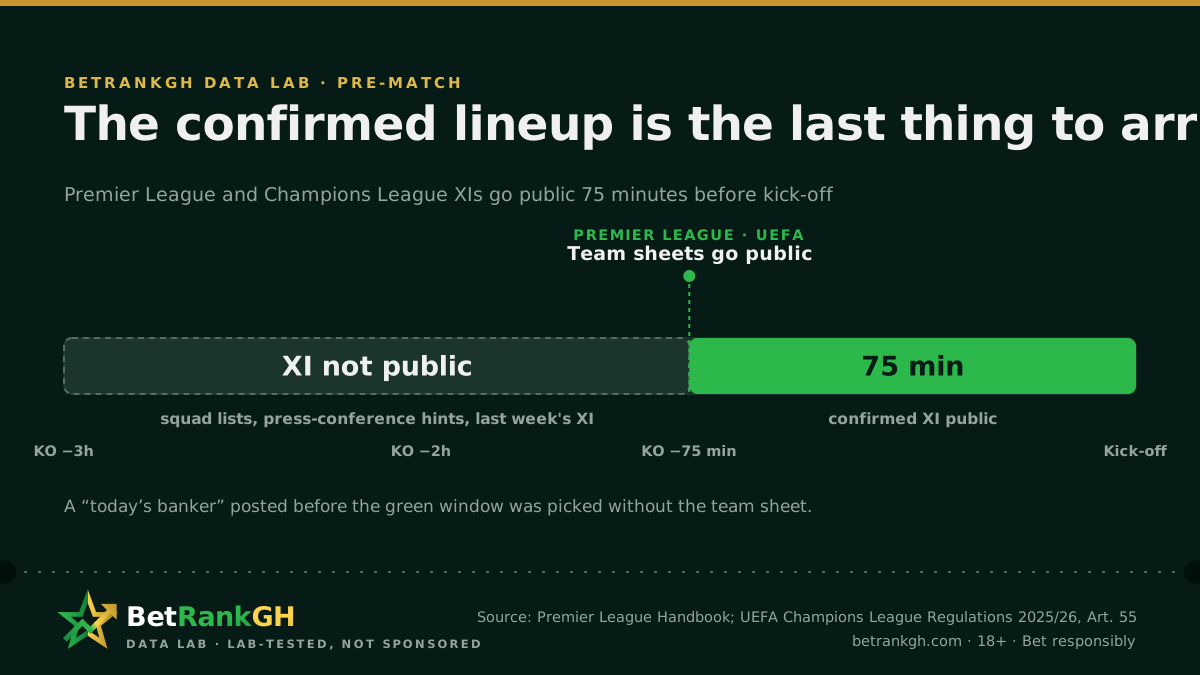
Since the 2024/25 season, Premier League clubs have had to submit their team sheets at least 75 minutes before kick-off, and that is also the earliest point the starting XIs can be made public. Before the change, the publication embargo was 60 minutes. UEFA's competitions run on the same 75-minute clock: Article 55 of the Champions League regulations has match sheets submitted at least 75 minutes before kick-off and exchanged no earlier than that. The EFL below the Premier League still uses 60 minutes.
In Ghana time, that window shifts twice a year. Ghana stays on GMT all year while the UK changes its clocks, so since the UK went back to GMT on 25 October a Saturday 3pm UK kick-off is also 3pm in Accra, with lineups out at 1:45pm. When the UK moves to summer time on 28 March 2027, the same fixture kicks off at 2pm Accra time and lineups land at 12:45pm.
For Ghana Premier League matches we couldn't find an equivalent published deadline for when lineups go public, so the clubs' own official social accounts on match day are the place to watch. Treat any "confirmed XI" for a GPL match that circulates hours before kick-off with suspicion until the club itself posts it.
Now set that against how prediction pages actually work. A banker posted at 9am for a 3pm kick-off was chosen six hours before anyone outside the dressing room knew who was playing. Whoever wrote it was working from squad lists, press-conference hints and last week's team. That's not a criticism of any one tipster, it's simply the order in which information arrives, and it's why the most useful time to make a decision is the hour most prediction pages have already gone quiet.
The 5-Minute Pre-Match Research Checklist
Run these in order once the team sheets are out. Each takes about a minute, and any one of them can be a reason to walk away.
1. Read the team sheet against what you assumed
Before you look at the lineup, write down the XI you expected, even roughly. Then compare. You're looking for three things: a missing goalkeeper, a missing first-choice centre-back or striker, and rotation, several changes at once from a manager protecting players for a bigger fixture. Team news has its biggest betting impact in exactly those spots, because they're the positions where a replacement is most clearly worse and where markets like both-teams-to-score or a player's goal price depend most directly on who starts. One change in midfield rarely moves anything. Four changes the day before a Champions League tie does.
2. Count the rest days, and don't over-read them
Check when each side last played and when they play next. A team coming off a Thursday European away trip into a Sunday league game, or a Ghanaian side back from a midweek CAF trip, is a candidate for rotation, and that's the real reason rest matters: it predicts changes to the XI you've just read.
Be careful turning rest into a prediction on its own. One analysis of roughly 9,000 English top-flight matches found teams on three days' rest won about 41% of the time, against about 34% after seven or eight days. That isn't because tired teams play better. The clubs playing every three days are mostly the strong ones in Europe and the cups, so the raw numbers mix fatigue up with quality. If a congested side has named its strongest XI anyway, the schedule alone is a weak reason to bet against it.
3. Ask what the match is worth to each side
Motivation is the softest check, so keep it concrete. Is either team playing a bigger fixture within the next four days? Is this a dead rubber for one side, already safe or already out of a cup? Is it a derby, where form tables tend to matter less? Don't invent a story about hunger or pressure. Note only what the fixture list and the table make objectively true, and let it explain anything odd you saw in check 1.
4. Read the market's movement as information
Compare the price now with the price earlier in the day. If your pick has shortened from 2.10 to 1.90, the market has absorbed something: team news, weight of money, or sharper bettors acting first. If it has drifted and you can't explain why from checks 1 to 3, assume someone knows something you don't, and treat that as a reason to stop, not a bargain. Closing prices are generally the market's best estimate of a match, though studies don't agree on how complete that estimate is. That's why a price that moved sharply against you after the team sheet deserves more respect than the opinion you formed before it.
5. Put your own number against the fair price, then shop it
Strip the bookmaker's margin out of the current odds (our guide to reading betting odds walks through the arithmetic in under a minute) and compare the fair probability with your own honest estimate after checks 1 to 4. No gap, no bet. If there is a gap, check the same price at more than one licensed bookmaker, because a 1.90 against a 2.00 on the same outcome is a real difference over a season. Shopping a price is the one part of this checklist a second account genuinely helps with. If you hold one, use only bookmakers licensed by the Gaming Commission of Ghana.
How to Analyse a Football Match Before Betting: A Worked Example
An illustrative case, not a real fixture. At 10am you like a Premier League home side at 1.80, about 55.6% implied, roughly 53% once a typical margin is stripped. Your own read says 58%, a small but genuine edge, so you wait.
The team sheet arrives 75 minutes before kick-off. Their first-choice striker is on the bench, they play a European tie on Wednesday, and two more regulars are rested (checks 1 and 2). The price has drifted to 2.05 (check 4), and the drift now makes sense: the market has repriced the weakened XI. Your honest estimate falls to around 45%, while the fair probability at 2.05 is about 46.5%. The edge that existed at 10am is gone. Someone who locked the bet in at 1.80 that morning backed the team they imagined, not the team that took the field. The checklist doesn't tell you who wins. It tells you that the bet you liked no longer exists.
Common mistake: The morning accumulator. A six-leg slip built at 10am across six afternoon kick-offs locks in all six selections before a single team sheet exists, and you can't remove one leg once a lineup goes against you. If you want multiple matches in one bet, build it after the last relevant lineup is out, or keep them as singles, and remember that each extra leg compounds the bookmaker's margin, as we showed in our look at the accumulator correlation trap.
What This Checklist Can't Do
It can't make a 50/50 match predictable, and it isn't a system that wins. Football has a lot of randomness in a single 90 minutes, and a well-reasoned bet still loses often. What the routine does is narrower and more useful: it stops you acting on stale information, it makes "no bet" a normal outcome rather than a failure, and it gives you a reason for every stake that you can check afterwards. If a tipster's pick survives all five checks, fine, but by then the decision is yours, built on the same information the market has.
If you're weighing up a paid or free prediction service, our audit of how accurate prediction sites really are, the breakdown of who actually pays for "free" tips and the warning signs of "sure banker" sellers are the natural next reads. For the in-play version of the same discipline, see our live betting guide.
Bet only what you can afford to lose, and if a five-minute checklist starts feeling like a reason to bet on every match rather than a reason to skip most of them, our responsible gambling page has free, confidential help available in Ghana.