Jackpot Betting in Ghana: SportyBet, Betika and the Real Math Behind Life-Changing Wins
SportyBet's jackpot asks you to predict the outcome of 12 football matches correctly for GHS 1. Betika's jackpots run similarly, ten to seventeen matches depending on which one you enter. Both dangle a prize pool that dwarfs anything a single match bet could pay out. What almost nobody shows you is the actual probability of getting there, and how that compares to the same money spent elsewhere.
At BetRankGH, we don't tip. We find where the odds don't match the actual probability, and jackpots are one of the clearest cases where the marketing (a huge number in bold) and the math (a genuinely tiny chance of reaching it) are telling two very different stories.
How the Jackpot Actually Works
SportyBet's 12-game jackpot runs weekly: pick a result (home, draw, or away) for each of 12 selected fixtures, stake GHS 1, and submit before the weekly cutoff. Get all 12 right and you take the largest share of the pool, currently structured around 30% to perfect tickets, with consolation shares (roughly 40% and 50% of smaller pools) going to the best 11/12 and 10/12 tickets respectively. Betika's jackpots follow the same shape with more matches on the biggest ones, which lowers the odds further in exchange for a bigger headline prize. Both are pool-based, not fixed-odds: you're not betting against the bookmaker on a set price, you're splitting a shared pool with everyone else who also got there.
The rollover mechanic is what keeps the headline number growing: in a week where nobody hits the top tier, that share of the pool typically carries forward into the following week's jackpot rather than being paid out at a reduced level. That's exactly why the advertised prize sometimes balloons well beyond a "normal" week's figure, several weeks of no perfect ticket stacking on top of each other. It also means the number in the marketing is a genuinely accurate account of what's on the table; the part that's missing is any sense of how many other tickets are chasing the same pool.
The Probability Math Nobody Shows You
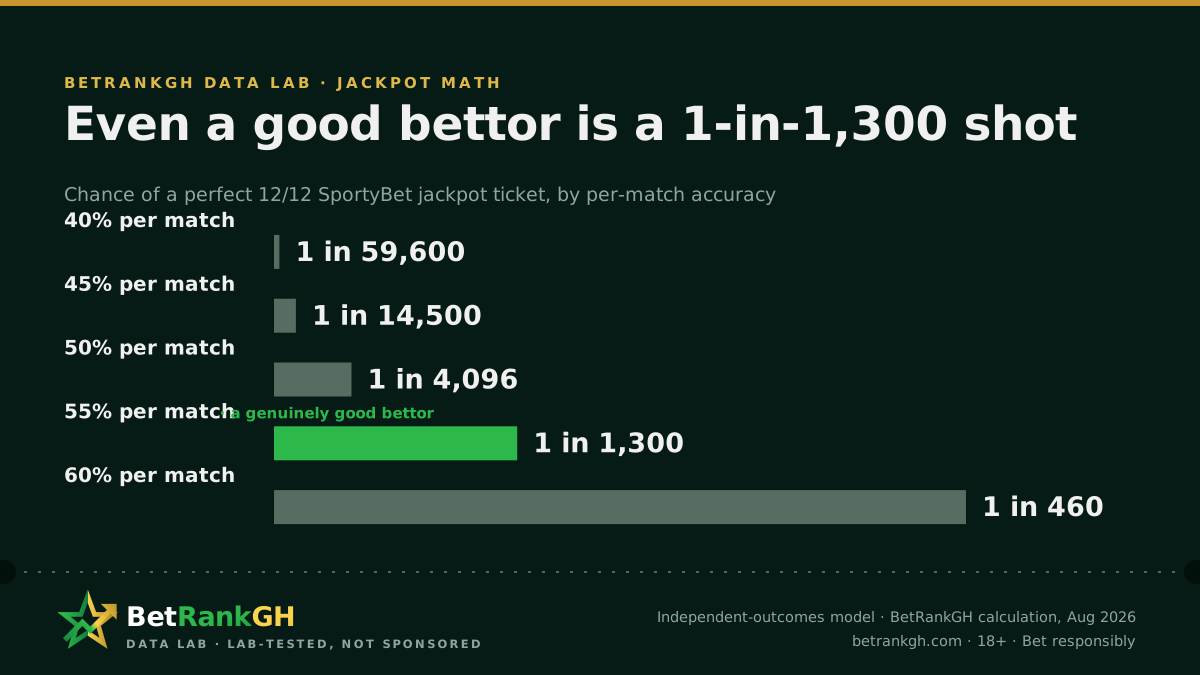
Treat each match as a coin you need to call correctly, and the maths compounds fast. Even a bettor genuinely better than a coin flip on every single leg, say 55% accurate per match, a strong number for consistently picking 1X2 outcomes, still has to survive that roll twelve times in a row.
That 55% row matters because it's a genuinely good strike rate, better than most bettors sustain across a season of 1X2 picks. Even there, the honest odds of a clean sweep sit around 1 in 1,300. Betika's longer jackpots (up to 17 matches) push the same math further out: the same 55% accuracy across 17 legs drops to roughly 1 in 25,000.
Sustaining even 55% across twelve genuinely varied fixtures is harder than it sounds, and it's worth being honest about why. Jackpot selections routinely mix heavy favourites with genuinely close matches, and the draw outcome, the hardest of the three 1X2 results to call reliably, shows up somewhere in almost every set of 12. A bettor might comfortably call eight or nine of the twelve with real confidence and be left guessing, effectively closer to a coin flip, on the rest. That blended reality is exactly why the 45-55% band is the realistic range for a genuinely skilled jackpot player, not the 70-80% a casual glance at "I'm pretty good at predicting football" might suggest.
What This Means Against a Real Prize Pool
Expected value here is simple in shape even without a live pool figure in front of you: take the current advertised pool, multiply by your realistic probability of landing the top tier, and compare that to your GHS 1 stake. At a 1-in-1,300 shot, a pool needs to be genuinely large, and importantly split among comparatively few perfect tickets, before the expected return on that GHS 1 gets anywhere close to fair. Most weeks, with thousands of entries competing for the same 12/12 tier, the math simply doesn't clear that bar. The prize pool number in the marketing is real; the odds of a single ticket capturing a meaningful share of it are the part that never makes the advert.
The One Honest Case for Playing Anyway
Jackpot pools that roll over week to week because nobody hits 12/12 do occasionally grow large relative to how many tickets are actually being sold that particular week. When a pool has rolled several times and ticket volume for that specific draw is unusually low, the expected value on a GHS 1 stake can genuinely improve, sometimes meaningfully. This is closer to how a rolled-over lottery jackpot behaves than a typical betting market. It doesn't change the variance, a 1-in-thousands shot is still a 1-in-thousands shot, but it's the one scenario where "the math isn't uniformly terrible" is actually true rather than wishful thinking.
Jackpot vs Single-Match Betting: The Real Trade-off
A single well-researched match bet with a genuine edge behaves completely differently from a jackpot ticket. The edge is small per bet, but it compounds favourably over volume: a bettor with a real 3-5% edge on match odds will see that edge show up reliably over hundreds of bets, because each one is an independent, moderate-probability event, not a twelve-way compounding chain. A jackpot ticket is the opposite: enormous variance, a prize that's genuinely life-changing if it lands, and a probability so small that "reliably showing up over time" doesn't apply in any practical sense within a normal bettor's lifetime of play.
Put the same weekly GHS 20 through both products and the shape of the outcome is completely different. Spread across single match bets at a genuine 3-5% edge, that GHS 20 a week compounds slowly but reliably over a year of consistent staking, the kind of grind our bankroll management guide is built around. Put the same GHS 20 into twenty jackpot tickets a week for a year, roughly a thousand tickets, and even at the generous 55% per-match accuracy, the chance of hitting 12/12 at least once across that entire year works out to just over a coin flip, about 53%. That sounds almost reasonable until you remember it's the cumulative result of a thousand separate tries, each one still an individual 1-in-1,300 shot, not a strategy that compounds the way a genuine per-bet edge does.
Neither is wrong to do. They're different products solving different things, entertainment and a lottery-sized dream on one side, a grindable long-run edge on the other, and treating a jackpot ticket as part of a serious staking strategy is where the confusion starts.
Trap Bet: Treating the 11/12 or 10/12 consolation tiers as making the jackpot "safer" than the headline odds suggest. Missing by just one or two games sounds close, but the probability of landing exactly 11 or 10 correct out of 12 is still governed by the same compounding math, and those consolation pools are typically far smaller than the top prize to begin with. "I'll probably at least get a consolation prize" is doing a lot of unearned optimism for what's still a low-probability outcome with a modest payout.
Note: If a jackpot ticket appeals, treat the stake exactly like a lottery ticket, an amount you're fully prepared to lose for a small dream, not a line item in a serious betting bankroll. And if betting ever stops feeling like a choice, our guide to free, confidential help in Ghana is there for you.