"Sure Banker" Sellers in Ghana: The WhatsApp Fixed-Match Scam and the Maths That Makes It Pay
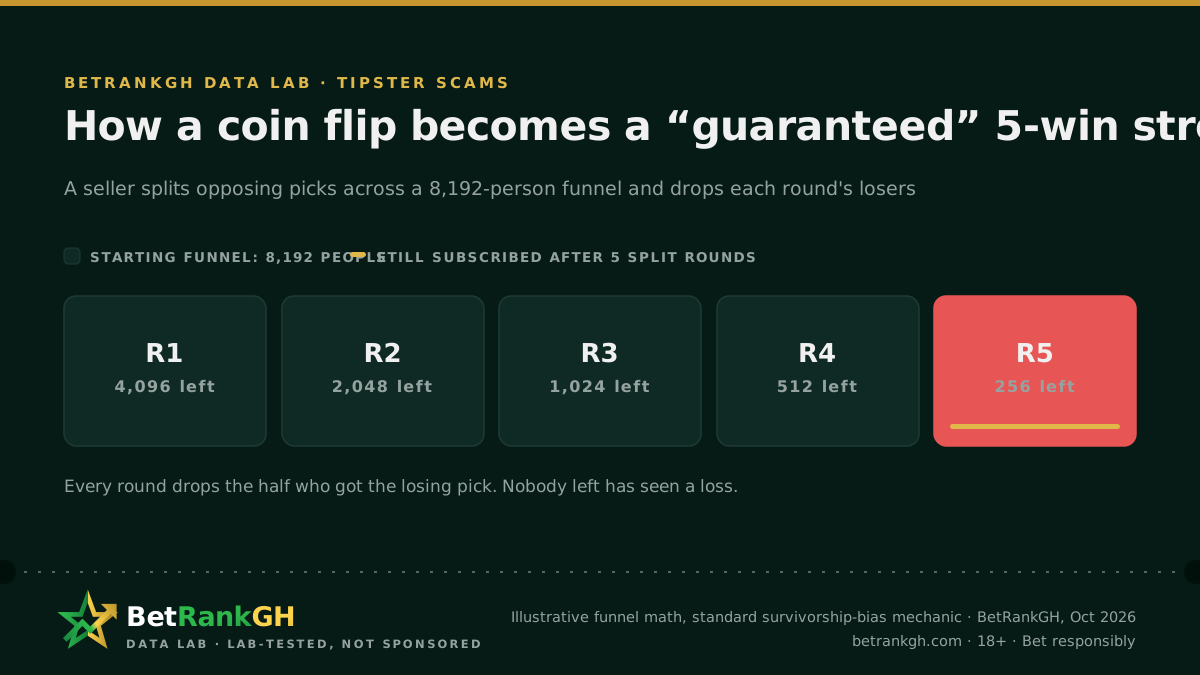
"Sure banker, 100% guaranteed, DM to subscribe." Every Ghanaian bettor has seen a version of this message, in a WhatsApp group, a Telegram channel, a Facebook comment section, often with a screenshot of five, ten, even twenty straight correct picks attached. At BetRankGH, we don't tip — we find where the odds don't match the actual probability. This piece is about a specific mechanic worth understanding before you ever consider paying for one of these: how a seller can show a genuinely real, unbroken winning streak to real subscribers while being wrong on roughly half of all the picks they send out.
The Mechanic: Splitting the List
The trick doesn't require fixing anything or possessing any real insight. It works on pure arithmetic. A seller starts with a large funnel, free channel members, trial subscribers, anyone who's shown interest, and before a round of matches, splits that group roughly in half. One half receives a tip backing Team A; the other half receives a tip backing Team B (or the opposite side of whatever market is in play). Whichever side wins, roughly half the original group has just seen a correct pick. The half that lost gets quietly dropped, muted, or moved to a different list. The half that won moves to the next round, where the split happens again.
Run the numbers and the effect is stark. Start with 8,192 people in the funnel. After one round of splitting, 4,096 of them have seen one correct pick in a row. Split again, and 2,048 have now seen two straight correct picks. By round five, roughly 256 people, about one in every 32 from the original group, have watched this seller call five consecutive winners with zero misses. To every person still in that final group of 256, the seller looks genuinely gifted. The seller has not won five picks in a row; across the full funnel, half of every single pick they sent out was wrong, every single time. What changed is which 256 people were still watching by the end.
Those 256 are also the exact people a seller approaches next with a paid "VIP" tier, and they're the ones whose screenshots get shared publicly as proof. Nobody shares a screenshot from the half that got dropped in round one, because that half has already unsubscribed, assuming the seller was simply wrong, with no way to know they were one half of a coin flip engineered to look like a streak.
It's worth being precise about what's actually happening at each split: it's a coin flip, dressed up as expertise. Backing Team A against Team B on an evenly-matched market is close to a genuine 50/50 proposition before any skill is applied, and the seller doesn't need the coin to land their way for the scheme to work, they only need enough people in the funnel that losing half of them every round still leaves a meaningful group at the end. The group of 256 after five rounds isn't evidence the seller called five 50/50 flips correctly through skill; it's exactly what you'd expect from flipping an actual coin 8,192 times and only telling the people whose side kept landing heads.
The Upsell Is the Real Business Model
The split itself usually isn't where the money is made, free predictions cost nothing to send. The business model is the escalation that follows: a free group builds the funnel, a "VIP" tier charges a weekly or monthly fee once a subscriber has survived enough rounds to trust the seller, and a further "premium" or "insider" tier charges more again, often timed right after the biggest apparent win. This is a related but distinct mechanic from the free-tipster affiliate economics we cover separately, where the money comes from a bookmaker's commission rather than a direct subscription fee; a splitting seller is paid directly by the subscriber, which is exactly why the illusion of a personal, earned track record matters so much to the pitch. The emotional pull of "I've personally watched this work five times in a row" is the entire product being sold.
When the Pitch Specifically Claims "Fixed"
A step beyond the "sure banker" pitch is the explicit "fixed match" claim, a direct assertion that the seller knows the result in advance because the match itself has been arranged. This claim carries its own problem, independent of the splitting mechanic: match-fixing is a real, documented issue in football, including in Ghana, where the Ashanti Gold vs Inter Allies match in 2021 (a 7-0 scoreline manufactured to settle a correct-score betting plot, later confirmed when a player admitted to deliberately scoring two own goals) remains the country's most notorious case. But genuine fixing operations are run quietly, by people with direct access to players or officials, exploiting a specific result privately for their own stake. There's no operational reason for someone with real advance knowledge of a fixed result to recruit strangers on WhatsApp and split the profit for a few cedis a week; doing so multiplies the number of people who could expose the scheme for no benefit to the fixer. A public offer to sell you a "fixed match" is, structurally, almost never what it claims to be.
Worth knowing too: ahead of the 2026/27 Ghana Premier League season, the Ghana Football Association moved to restrict betting companies from offering odds on domestic league matches at all, specifically citing match-fixing integrity concerns, with legal action pursued against operators placing unauthorised odds on GPL fixtures. Enforcement is reportedly a genuine ongoing fight, since GCG-licensed operators and offshore platforms both continue to offer odds in practice, but the policy itself is a real, current signal of how seriously fixing risk is being taken around the domestic game right now, not a reason to trust a stranger claiming private access to the outcome.
The GFA has also run a dedicated WhatsApp reporting channel for suspected match manipulation since 2020, a genuine, official avenue that exists precisely because fixing is treated as a real integrity threat rather than a theoretical one. If you ever encounter something that looks like an actual approach to fix a result, rather than just an exaggerated tipster pitch, that's the right channel, not a betting decision.
Why the Pitch Still Works
None of this requires the people who subscribe to be careless. Three ordinary psychological patterns do the real work. Recency bias means you weigh the streak you were personally shown far more heavily than any abstract warning about splitting; you watched five correct picks land with your own eyes. Social proof means a channel full of other subscribers celebrating wins (the same survivorship effect, repeated across every member who made it that far) feels like independent confirmation. And sunk cost means that once you've already paid for this week's "VIP" access, the instinct is to see it through rather than write off what you've spent, which is exactly the moment a losing pick gets explained away as bad luck rather than treated as the real signal it is.
The One Question That Actually Tests a Seller
There's a single question that cuts through the splitting mechanic entirely, because it's the one thing a seller running this trick cannot answer honestly: how many picks did you send out today, and to how many different people, and did everyone receive the same one? A legitimate analyst sends one pick to their entire audience and has a real, public, dated record of every call, wins and losses both, same as the closing-line-value test we cover in our look at prediction-site accuracy claims. A seller running the split can't answer that question without admitting the mechanic, because the honest answer is that different people in their own audience received opposite picks on the same match.
If a seller won't answer, or the record they show you is a group-specific chat history rather than something published and dated for everyone to see, you're very likely looking at the surviving branch of a split, not a genuine track record.
Trap Bet: Judging a tipster by the streak you personally witnessed. By construction, if the mechanic above is in play, everyone still subscribed has witnessed an unbroken streak, that's the entire design. A real streak and a survived streak look completely identical from inside the surviving group. The only way to tell them apart is to ask about the people who aren't in the group anymore, which is precisely the question a seller running this trick hopes you never think to ask.
None of this means every person offering betting advice online is running a splitting scheme, plenty of genuine, if still imperfect, analysis exists, and our own breakdown of why most betting predictions fail covers the honest version of this problem. It means a streak alone, however long, however many screenshots back it, is never proof of anything, because a streak is exactly what this mechanic is built to manufacture. The question that matters was never "how many did they get right." It's always "right, compared to how many people were told something else."
Note: A different, crash-game version of manufactured signal selling runs through our Aviator predictor scam breakdown. Converting any genuine price into a real probability is covered in our guide to reading betting odds. And if betting ever stops feeling like a choice, our guide to free, confidential help in Ghana is there for you.